
Engelbert of Nassau’s Book of Hours
Exhibitor
Universal Art Group | Verlag Müller & Schindler
In the 1470s, one of the most extraordinary and remarkable Books of Hours of the Middle Ages was created in Burgundy. The miniatures, crafted by the renowned Master of Mary of Burgundy, along with countless decorative details—flowers, vines, and hundreds of birds—give the manuscript its unique character.
This delicate manuscript, with almost 300 leaves, has been divided into two volumes since the 18th century. The facsimile edition faithfully reproduces the manuscript in its current state and strictly limited to 900 copies worldwide. The original manuscript is held under the signature MSS. Douce 219/220 in the Bodleian Library in Oxford.
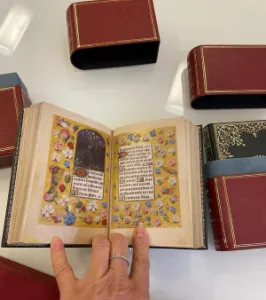
The open volume shows folios 97v and 98r. The elegance and refinement of the decoration, dominated by delicate tendrils and enlivened by hundreds of birds, on many pages gave way in the course of the modification to the radiant beauty of luminous backgrounds strewn with flowers and tendrils.
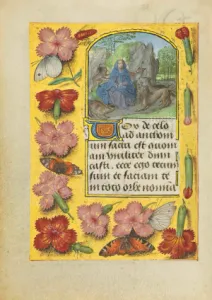
Fol. 36v: Antonius Abbas is resting at the foot of a rock, inquisitive wild animals have gathered around him, and a pig – often depicted together with him – is looking up at him from the left foreground. The miniature above the saint’s suffragium is surrounded on all sides by a trompe-l’oeil border, which had not originally been present but was added later to accommodate changes in the sense of style. Blossoms and buds appear to be strewn on the golden backdrop, on which they also cast shadows.
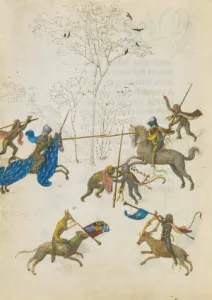
Fol. 132v: Here we are witnessing a fantastic tournament: the monkey riding the unicorn with the “e” of Engelbert of Nassau on its saddlecloth is jousting with another contestant on horseback. A fox on a ram and a wild man riding a stag are blowing trumpets adorned with flags – that on the left bears the subsequently added coat of arms of Duke Philip the Handsome. Four squires – wild men and monkeys – are excitedly attending the joust on foot and have further lances at the ready in case the first two should splinter.
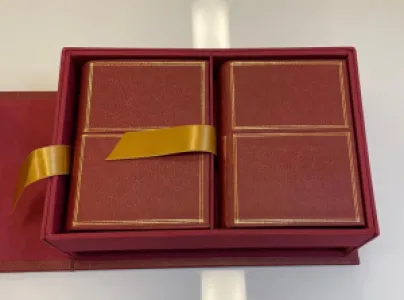
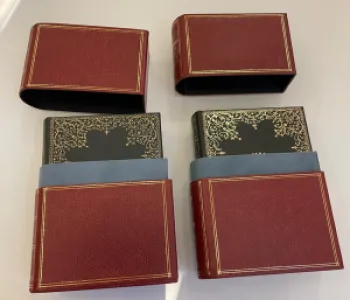
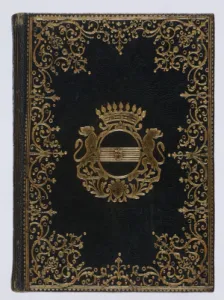
The manuscript, divided here into two volumes, is bound in a magnificent leather cover with lavish gold embossing. The manuscript has been divided into two volumes since the 18th century; this is faithfully reproduced in the present edition. Bound in genuine leather with lavish gold embossing, the volumes are protected by red leather sheaths, likewise with gilt embossing, and delivered in an elegantly luxurious box.